
Perspective

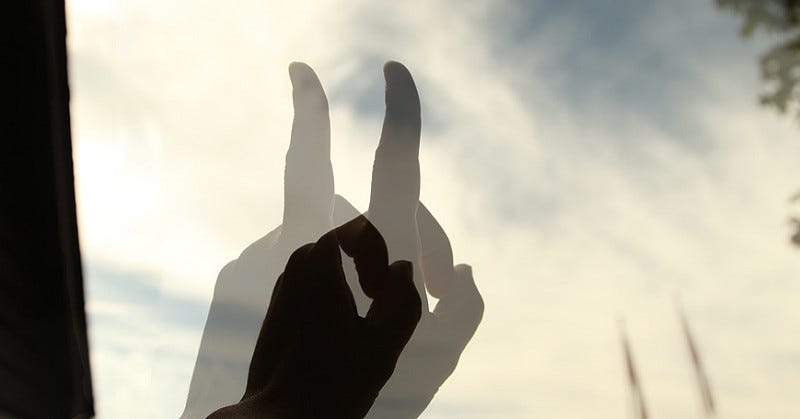
Parallax is the apparent shift in an object’s position when the observer’s viewpoint changes. When you move your head, or simply switch from one eye to the other, near objects seem to move more than distant ones, even though nothing has actually moved. Hold your finger at arm’s length and look at a distant object with one eye closed. Then switch eyes. Your finger appears to jump sideways, while the distant object barely moves. That difference in apparent movement is parallax.
And that simple reality presses into something deeper: how we look at things shapes how we understand them. This is true, not only in the physical world, but in the unfolding of our lives. If our perspective is limited to what we see in the moment, we’re left reacting within a narrow frame. Facts don’t interpret themselves; they must be understood in context. And if the context is wrong, the conclusions will be wrong. As finite creatures, we know very little on our own (almost nothing). We don’t see the full past, we barely grasp the present, and we can’t see the future at all. Left to ourselves, we live with profound uncertainty. Much of what we “know” has come to us by authority, parents, teachers, books, etc., and we have trusted their testimony.
There’s a simple illustration of this. A man once visited Seattle, and it rained every day for two weeks. He saw a young boy and asked, “Do you live here?” The boy said, “Yes.” The man then asked, “Does it rain here every day?” The boy replied, “I don’t know; I’m only seven.” The point is clear: no human being has a wide enough vantage point, on their own, to draw ultimate conclusions (the “problem of induction”).
But God does. He is omniscient; He knows all things, past, present, and future, and He knows how they all fit together. He alone has perfect perspective. Now, we can’t know everything He knows; we’re finite and always will be. As the comedian Steven Wright quipped, “You can’t have everything; where would you put it?” Still, God hasn’t left us in the dark. He has revealed Himself through His Word, through the world He made, and supremely through His Son. That means we can know some things truly and with certainty. We know that He is all-knowing, all-wise, all-powerful, and all-good. We know that He loves His people. And that knowledge reframes everything. It gives us a truer perspective on our lives. We begin to see that we are not adrift in random events but living within a story God is writing. We know how the story begins, we understand something of what He is accomplishing, and we are told how it ends.
We know that He is working all things together for good for those who love Him and are called according to His purpose. Even the hard things are not outside His plan. His providence is constant and personal; He knows when a sparrow falls, and He numbers the hairs on our heads (fewer than they once were, perhaps). Nothing surprises Him. And because of that, we’re given a better vantage point from which to interpret everything that comes.
More than that, we’re told how the story concludes. We’re invited to look ahead—to the end of the book—to the marriage feast in a new heavens and a new earth, where joy is full and knowledge deepens forever. There, we will delight in the infinite God without end. And knowing that changes how we see everything now.
I ran across this in a book, which cited an excerpt from, J. Gresham Machen’s essay, Things Unseen:
To me nature speaks clearest in the majesty and beauty of the hills. One day in the summer of 1932, I stood on the summit of the Matterhorn in the Alps. Some people can stand there and see very little. Deprecating the Matterhorn is a recognized part of modern books on mountain climbing. The great mountain, it is said, has been sadly spoiled. Why, you can even see sardine cans on the rocks that so tempted the ambition of climbers in Whymper’s day. Well, I can only say that when I stood on the Matterhorn I do not remember seeing a single can. Perhaps that was partly because of the unusual mass of fresh snow which were then on the mountain, but I think it was also due to the fact that unlike some people, I had eyes for something else. I saw the vastness of the Italian plain, which was like a symbol of infinity. I saw the snows of distant mountains. I saw the sweet green valleys far, far below, at my feet. I saw the whole glorious round of glittering peaks, bathed in an unearthly light. And as I see that glorious vision again before me now, I am thankful from the bottom of my heart that from my mother’s knee I have known to whom all that glory is due.