

Two Enemies of Christian Community
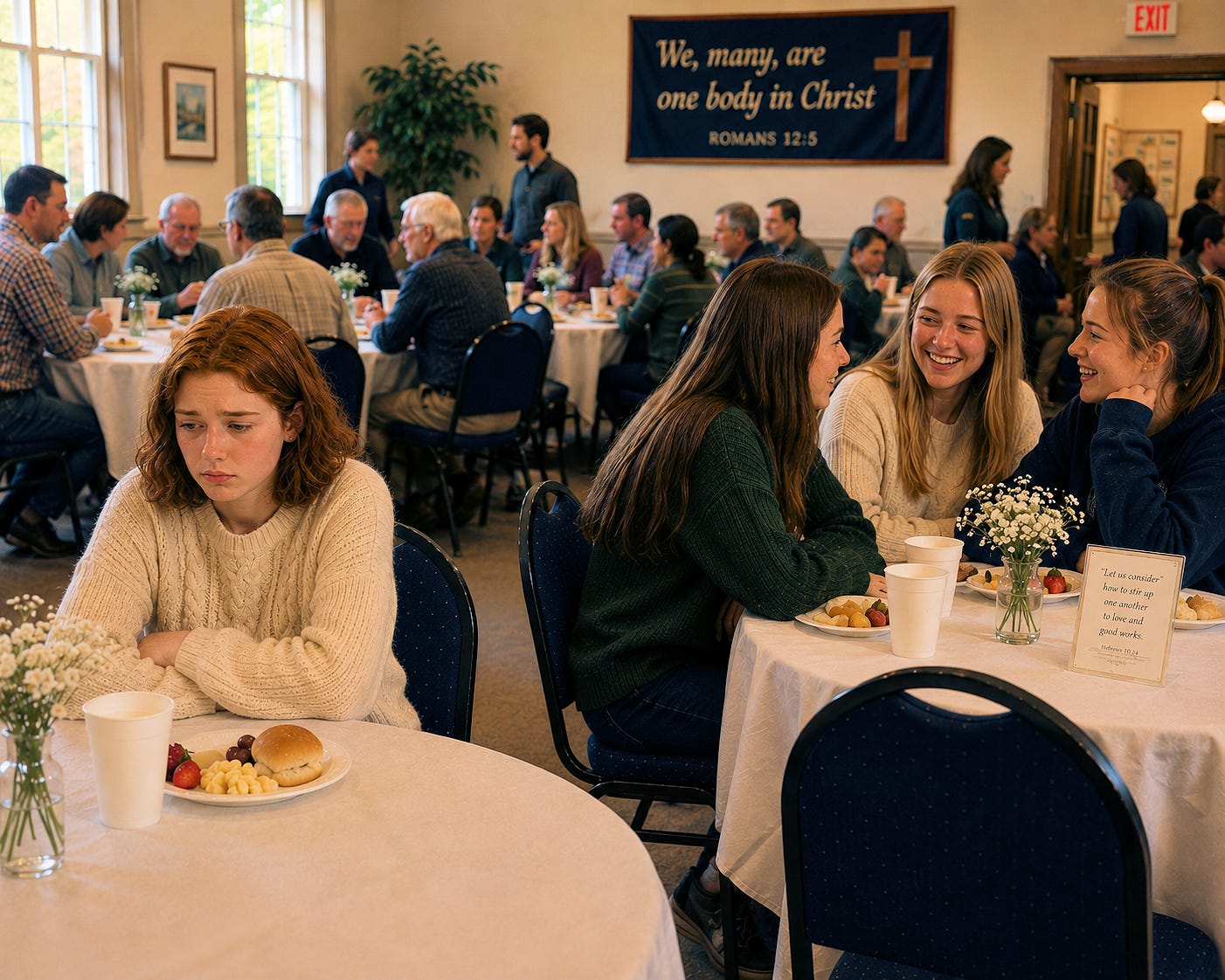
Christian community is often undermined by two forms of isolation. The first is group isolation, commonly called a clique. The second is individual isolation, the cloistered person who remains detached from the life of the body. Both forms of isolation damage the communion, and both ultimately harm those who are isolated. Let us consider each in turn.
Cliques
Cliques usually develop spontaneously rather than deliberately. As the old saying goes, “Birds of a feather flock together.” We are naturally drawn to people who share our interests, personalities, backgrounds, or stage of life. Friendships are good gifts from God. Other associations naturally arise through work, school, hobbies, sports, age, or similar experiences. None of these relationships is inherently wrong. Indeed, they often bring genuine blessings.
The danger arises when these relationships become increasingly exclusive. That exclusivity may not be intentional, but if it is left unchecked, the inertia of human nature takes over. We gradually become comfortable with “our people” and overlook everyone else. Teenage girls often excel at this, teenage boys are not far behind, and adults are by no means immune.
The Apostle Paul warns against this tendency:
“Be of the same mind toward one another. Do not set your mind on high things, but associate with the humble. Do not be wise in your own opinion.” —Romans 12:16
As members of Christ’s body, we belong to every other member of the body—not merely to those with whom we share the strongest affinity. God adds people to His church for His own wise purposes. Every believer brings strengths from which we may benefit and weaknesses to which we are called to minister. We are to serve one another and be served by one another.
This is precisely why the New Testament is filled with “one another” commands. We are to love one another, honor one another, welcome one another, build up one another, admonish one another, bear one another’s burdens, forgive one another, encourage one another, pray for one another, show hospitality to one another, and stir up one another to love and good works. None of these commands can be faithfully obeyed if we restrict our fellowship to a small circle of friends.
Christian community requires us to move beyond our preferred companions and embrace the whole family of God.
The Cloistered Christian
The second form of isolation is individual isolation—the cloistered Christian.
Some people are naturally quiet or reserved and therefore find it easy to withdraw from others. Yet the Christian life does not call us merely to follow our natural inclinations. It calls us to supernatural transformation. The Holy Spirit teaches us to deny ourselves, love our neighbors, and put the interests of others before our own.
Hebrews exhorts us:
“And let us consider one another in order to stir up love and good works, not forsaking the assembling of ourselves together... but exhorting one another, and so much the more as you see the Day approaching.” —Hebrews 10:24–25
Notice that we are not merely commanded to attend; we are commanded to consider one another. We gather with a purpose: to encourage, strengthen, and serve our brothers and sisters.
It is possible to be physically present with the body while remaining emotionally and spiritually absent. We can sit quietly, waiting for someone else to initiate conversation or ministry, or we can actively look for opportunities to encourage others.
Sometimes people isolate themselves because they are afraid of being known. Being known is risky, but it is also necessary. The very areas we seek to hide are often the areas where God intends to mature us through the love, counsel, and correction of fellow believers.
Others remain isolated because they have little interest in knowing others. If we never know them, we will never feel responsible for them. But Christian love does not permit such detachment. We are members of one another.
Ironically, what often masquerades as humility is really a subtle form of self-centeredness. Genuine humility forgets itself in order to serve others. False humility remains preoccupied with itself—its fears, its insecurities, its disappointments, even its self-pity.
Both cliques and cloistering undermine the life of the church. One isolates groups from the body; the other isolates individuals from the body. Both resist the very means God has ordained for our growth. The church is not simply a gathering of individuals occupying the same room. It is the living Body of Christ, where every member needs every other member. We grow in grace, not in isolation, but together. We are a loving communion.