
Antony Flew the Coop

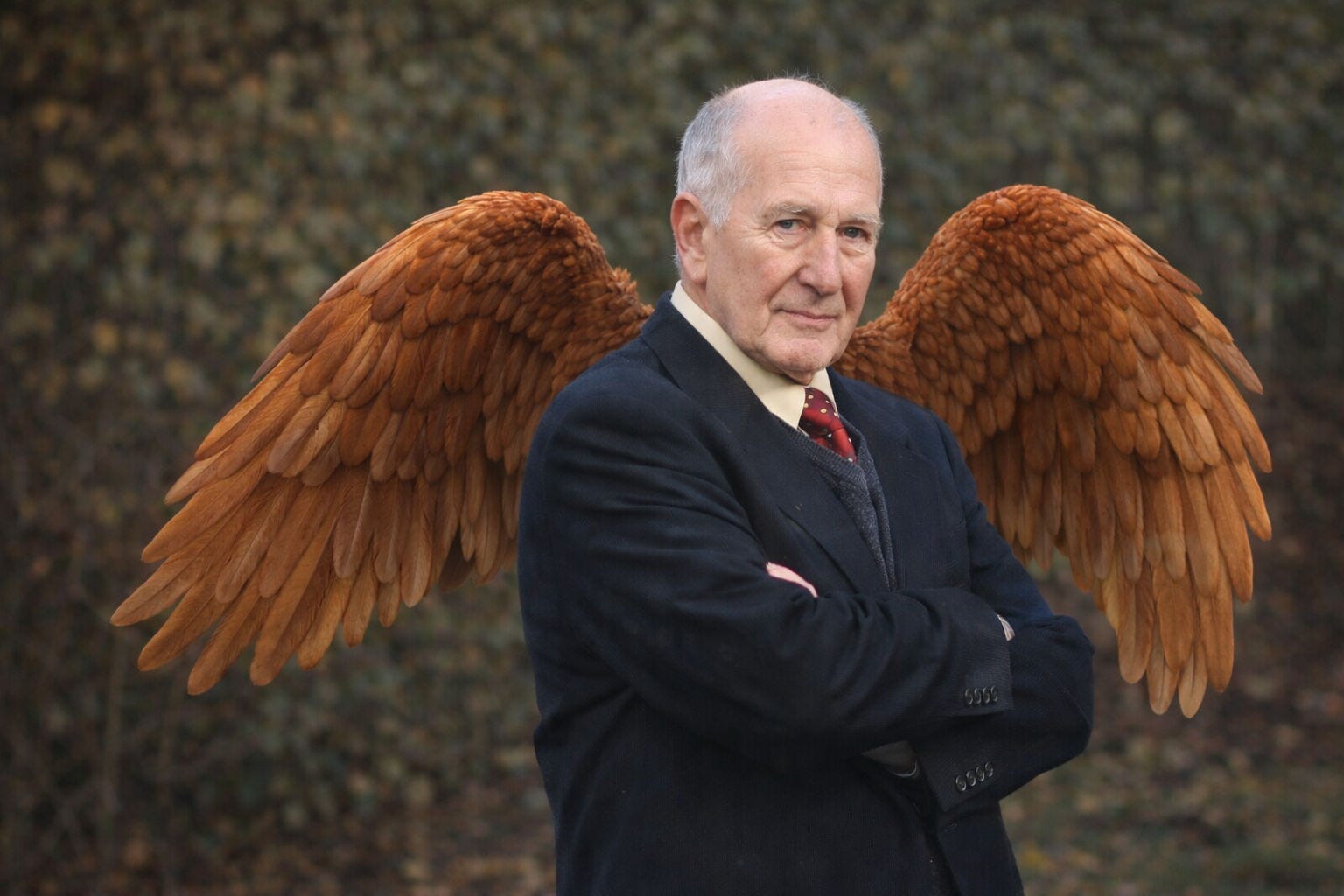
Antony Flew’s There Is a God: How the World’s Most Notorious Atheist Changed His Mind offers a fascinating glimpse into the intellectual journey of one of the twentieth century’s most influential philosophers. Having abandoned the ranks of professed atheism, Flew now occupies the “respectable” territory of deism. At eighty-five years of age, one hopes that his philosophical expedition has reached its earnest conclusion. And yet, like Agrippa, Flew remains almost persuaded. Still holding tightly to his rationalism, Flew nonetheless offers this striking concession:
As I have said more than once, no other religion enjoys anything like the combination of a charismatic figure like Jesus and a first-class intellect like St. Paul. If you’re wanting omnipotence to set up a religion, it seems to me that this is the one to beat!
From a Christian perspective, little in the book is novel in terms of argumentation. The case Flew now finds compelling consists largely of familiar arguments—cosmological, teleological, and moral—updated in light of contemporary scientific discoveries. While these arguments may be old news to believers, they are clearly new to Flew. That fact alone makes the book compelling. It is no small thing to watch a skeptic of such notoriety publicly concede ground. Not only does Flew leave atheism behind, he also fires a few Parthian shots on his way out.
The book is coauthored by Roy Abraham Varghese, who contributes an appendix titled, “The ‘New Atheism’: A Critical Appraisal of Dawkins, Dennett, Wolpert, Harris, and Stenger.” I was pleasantly surprised to encounter the following distinctly presuppositional passage:
Three things should be said about these phenomena [i.e., rationality, life, consciousness, conceptual thought, and articulating and understanding meaningful symbols], and their application to the existence of God. First, we are accustomed to hearing about arguments and proofs for God’s existence. In my view, such arguments are useful in articulating certain fundamental insights but cannot be regarded as “proofs” whose formal validity determines whether there is a God. Rather, each of the five phenomena adduced here, in their own way, presuppose the existence of an infinite, eternal Mind. God is the condition that underlies all that is self-evident in our experience.
Second, as should be obvious from the previous point, we are not talking about probabilities and hypotheses, but about encounters with fundamental realities that cannot be denied without self-contradiction. In other words, we do not apply probability theorems to certain sets of data but ask the far more basic question of how it is possible to evaluate data at all. God is not deduced from complex phenomena; rather, God’s existence is presupposed by all phenomena.
Third, atheists—new and old—complain that there is no evidence for God’s existence, while some theists reply that free will requires such evidence to be non-coercive. The approach taken here is that we already possess all the evidence we need in our immediate experience, and that atheism of any variety results only from a deliberate refusal to “look.”
A second appendix is contributed by N. T. Wright, who defends the claim “that there is a self-revelation of God in human history in the person of Jesus Christ.” Flew himself acknowledges the force of this argument:
The claim is defended by one of today’s premier New Testament scholars, Bishop N. T. Wright. In my view, Wright’s responses to my previous critiques of divine self-revelation, both in the present volume and in his books, comprise the most powerful case for Christianity that I have ever seen.
Flew concludes the book on a note that is, at the very least, hopeful:
Is it possible that there has been or can be divine revelation? As I said, you cannot limit the possibilities of omnipotence except to produce the logically impossible. Everything else is open to omnipotence.
Whether Flew ever crossed the final threshold remains an open question. But his journey—from atheism to deism, and to the very doorstep of Christianity—stands as a remarkable intellectual and philosophical pilgrimage, one that deserves careful attention.